Stick together
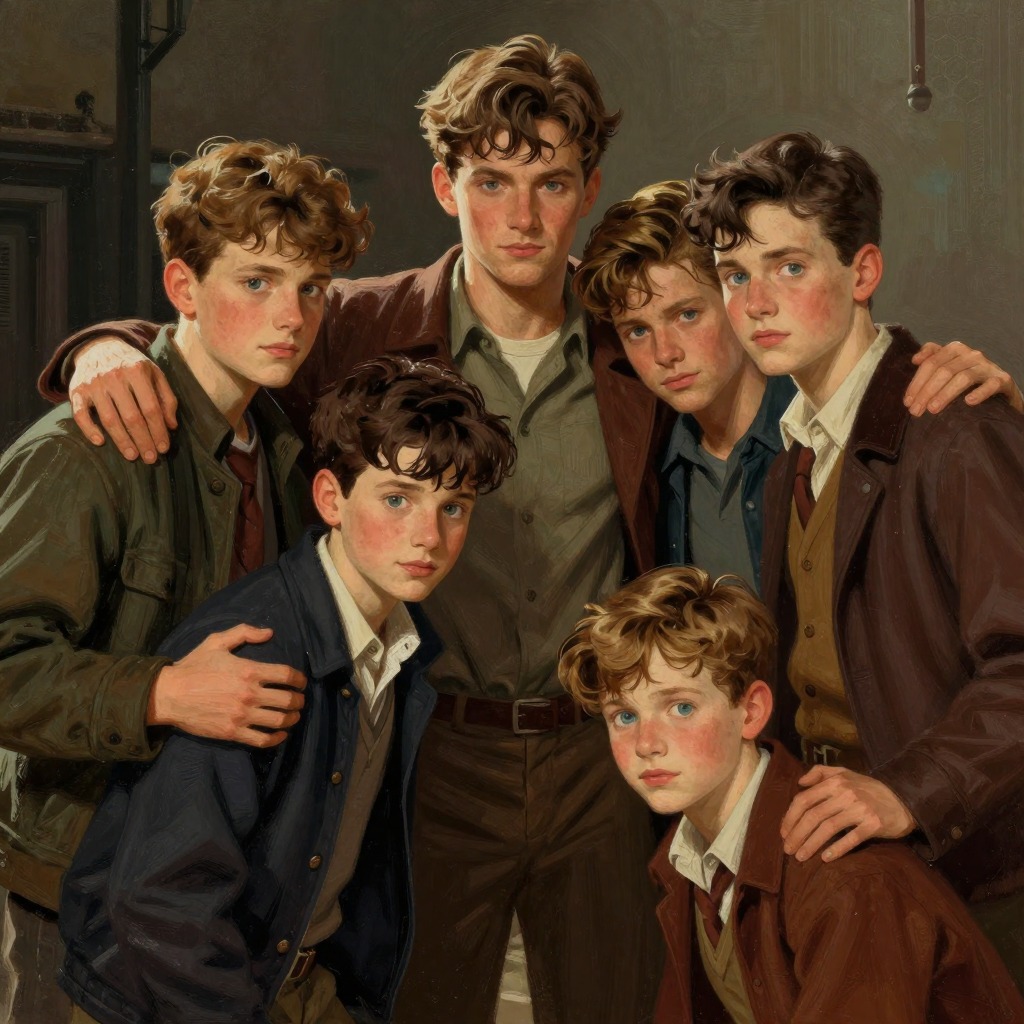
Stick together is the unwritten but absolute law of the greaser gang, a code that transforms a loose collection of neighborhood boys into a surrogate family. It demands that members defend one another without question, share what little they have, and never abandon a buddy, no matter the cost. This rule is the gang's answer to the hostility of the Socs and the indifference of the larger world, and it is tested, broken, and ultimately reaffirmed over the course of the novel.
Identity and Foundation of the Rule
The rule emerges from the conditions of the East Side, where poverty and constant threat from the Socs make isolation dangerous. Ponyboy Curtis explains that greasers "steal things and drive old souped-up cars and hold up gas stations and have a gang fight once in a while," but the gang itself is not merely a criminal enterprise; it is a tight-knit group of boys who "have grown up with and consider family." They are "almost as close as brothers," and this closeness is a survival mechanism. The rule is explicitly stated by Ponyboy: "You take up for your buddies, no matter what they do. When you're a gang, you stick up for the members. If you don't stick up for them, stick together, make like brothers, it isn't a gang any more. It's a pack. A snarling, distrustful, bickering pack like the Socs in their social clubs or the street gangs in New York or the wolves in the timber." This distinction between a gang and a pack is central: the greasers' unity is what separates them from the cold, impersonal violence of their enemies. The rule also has a practical corollary: "Don't get caught." As Two-Bit Mathews explains, if a member like Dallas Winston gets spotted slashing tires, he pays the price in a fair fight, but there will be no blood feud; the gang will still show up if needed tomorrow. This is not a license for reckless behavior but a framework for managing conflict within and outside the group.
The Gang as Surrogate Family
The stick-together rule is most powerfully expressed in the gang's role as a substitute for broken or absent families. Johnny Cade, whose father beats him and whose mother ignores him, "would have run away a million times if we hadn't been there. If it hadn't been for the gang, Johnny would never have known what love and affection are." The gang provides the emotional support and physical protection that his own home denies him. Similarly, the Curtis brothers—Ponyboy, Sodapop, and Darrel Curtis—are allowed to stay together only as long as they behave, following their parents' death in an auto wreck. The threat of being split up and sent to a boys' home hangs over them, making their unity a fragile, hard-won achievement. The gang's front door is always unlocked "in case one of the boys is hacked off at his parents and needs a place to lay over and cool off." Steve Randle, whose father periodically kicks him out, often sleeps on their sofa. This open-door policy is a literal enactment of the stick-together rule: the gang provides a home when biological families fail.
Testing the Rule: Conflict and Sacrifice
The rule is tested repeatedly through violence and moral crisis. When Ponyboy is jumped by five Socs, the gang immediately comes to his rescue, chasing off the attackers. When Johnny kills Bob Sheldon in self-defense, the gang's loyalty is pushed to its limit. Dallas Winston, without hesitation, gives the boys a gun, money, and a plan to escape to an abandoned church on Jay Mountain, risking his own freedom. Ponyboy reflects that "Dallas Winston could do anything," and the gang's trust in him is absolute. Even when Johnny decides they should turn themselves in, Dally's initial anger gives way to a plea: "Johnny, I ain't mad at you. I just don't want you to get hurt. You don't know what a few months in jail can do to you. Oh, blast it, Johnny... you get hardened in jail. I don't want that to happen to you. Like it happened to me..." This moment reveals that the stick-together rule is not just about physical defense but about protecting each other from the emotional and psychological damage of their world. The rule also governs the gang's internal conflicts. When Ponyboy, in a moment of anger, cruelly tells Johnny that "you ain't wanted at home, either," Two-Bit slaps him and threatens to "beat the tar out of you" if he weren't Soda's kid brother. The punishment is swift and harsh because the rule demands that members never turn on each other, especially the most vulnerable.
The Rule's Limits and Ultimate Meaning
The stick-together rule has limits, and the novel confronts them directly. Dally, the toughest and most hardened member, ultimately cannot bear Johnny's death. He robs a grocery store and, when cornered by police, raises an unloaded gun, forcing the officers to shoot him. Ponyboy realizes that "Johnny was the only thing Dally loved. And now Johnny was gone." The rule could not save Dally from his own despair. Yet the rule also provides the framework for the novel's resolution. After the rumble, Ponyboy's brothers and the remaining gang members rally around him during his illness and recovery. The hearing that could separate the Curtis brothers ends with the judge acquitting Ponyboy, and the family stays together. In the final scene, Ponyboy, Sodapop, and Darrel Curtis race home together, and Ponyboy notes, "I guess we all just wanted to stay together." The stick-together rule, tested by death and loss, is reaffirmed as the only thing that makes their harsh world bearable. It is the foundation of their identity as greasers, the source of their strength, and the promise that, no matter what, they will not face the world alone.